
Ask most people what they think of when they hear ‘root canal’, and the answer is usually some version of the same thing: fear. It is one of the most anxiety-inducing phrases in dentistry, and for many patients in India, the thought of root canal treatment is enough to delay seeking care — sometimes for months.
Here is what is worth knowing: the reputation root canal treatment has does not reflect what modern RCT actually involves. The procedure has evolved significantly, and when it is performed by an experienced team in a well-equipped clinic, most patients find it far less uncomfortable than the toothache that brought them to the clinic in the first place.
At Phoenix Multispecialty Dental Clinic, we have built our approach to root canal treatment around one goal: making sure that every patient who needs this treatment gets through it feeling informed, comfortable, and in control.
What Root Canal Treatment Actually Is
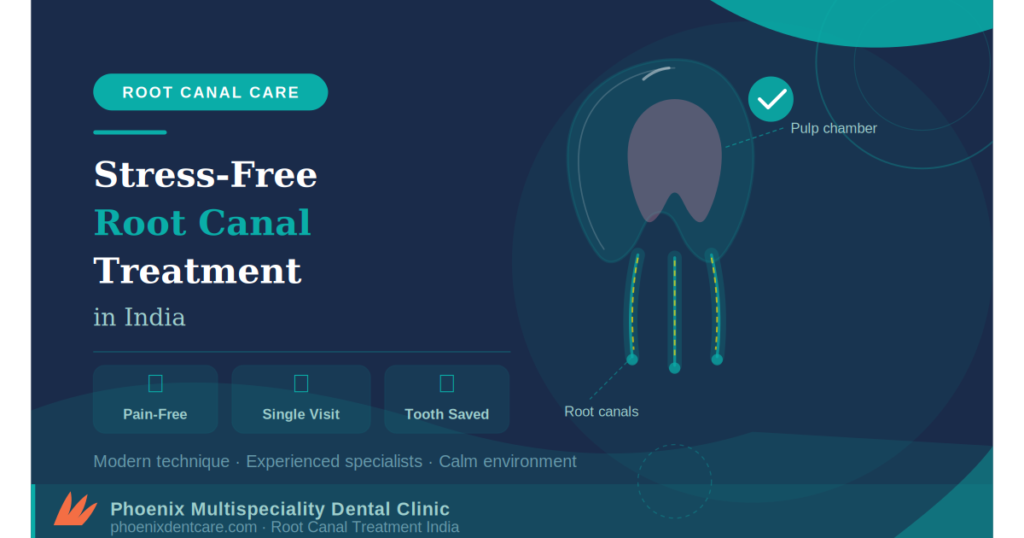
A root canal becomes necessary when the pulp — the soft inner tissue of a tooth that contains nerves and blood vessels — becomes infected or severely inflamed. This typically happens as a result of deep decay, a crack in the tooth, or repeated dental procedures on the same tooth.
Left untreated, an infected pulp does not heal on its own. The infection can spread to the surrounding bone and tissue, causing more serious problems. Root canal treatment resolves this by removing the infected pulp, cleaning and shaping the root canals, and sealing the tooth to prevent re-infection.
The goal is to save the natural tooth — which is almost always preferable to extraction, both functionally and in terms of long-term oral health.
Why So Many Patients Are Afraid — And What Has Changed
The fear associated with root canal treatment is largely rooted in older experiences — or stories passed down from people who had the procedure done years ago when techniques and anaesthesia were less refined.
Modern root canal treatment is a very different experience. Today’s techniques are more precise, more efficient, and more focused on patient comfort than ever before. Effective local anaesthesia means the procedure itself should not be painful — most patients report feeling pressure and movement rather than pain.
The challenge is not the procedure. It is the anxiety that precedes it. And that is something Phoenix addresses directly.
How Phoenix Makes Root Canal Treatment Stress-Free
Honest, Clear Communication Before Anything Else
At Phoenix, the process starts with a thorough consultation and a genuinely honest conversation. We explain what root canal treatment involves, what you will feel, how long it will take, and what to expect during recovery. We do not rush this conversation.
Most patient anxiety comes from uncertainty — not knowing what is about to happen is far more frightening than understanding it. We take the time to make sure every patient going into RCT knows exactly what the procedure involves, step by step.
Effective Anaesthesia — No Surprises
The most common fear patients express is that they will feel pain during the procedure. At Phoenix, we take anaesthesia seriously. Before any treatment begins, we ensure that the area is fully and effectively numbed — and we check in with patients throughout the procedure.
If at any point a patient is feeling discomfort beyond pressure, we stop and address it. No one at Phoenix is expected to simply endure something uncomfortable. This is a commitment we make to every patient who comes to us for root canal treatment.
A Calm, Unhurried Environment
Dental anxiety is real, and it is not helped by a rushed clinical atmosphere. Phoenix is designed to feel calm. Our team communicates at every step — telling patients what we are about to do before we do it, checking in regularly, and ensuring that the patient has control over the pace of the appointment.
Patients are welcome to raise their hand at any time to pause the procedure. That simple reassurance — knowing that they are not trapped in the chair — makes a significant difference to how patients experience treatment.
Modern Equipment and Techniques
Phoenix uses current endodontic techniques and well-maintained equipment for root canal treatment. This means the procedure is more precise, typically faster than older approaches, and associated with less post-procedure discomfort. The combination of modern technique and experienced practitioners means that root canal treatment at Phoenix is clinically as smooth as it can be.
Post-Treatment Support
The care does not end when the procedure does. Phoenix provides clear, practical post-treatment guidance — what to expect in the days following treatment, what is normal, what to watch for, and who to contact if something does not feel right.
Most patients experience some mild soreness for a day or two after root canal treatment, which is entirely normal and manageable. Knowing this in advance prevents unnecessary worry. Having a team to call if questions arise prevents it from escalating.
What to Expect: The RCT Process at Phoenix, Step by Step
Here is a straightforward overview of what root canal treatment involves at Phoenix:
- Consultation and diagnosis: X-rays are taken to assess the extent of infection and plan the treatment.
- Anaesthesia: The tooth and surrounding area are numbed with local anaesthetic. The procedure begins only when the patient is comfortable.
- Access and cleaning: A small opening is made in the tooth. The infected pulp is carefully removed and the root canals are cleaned and shaped.
- Sealing: The cleaned canals are filled and sealed with a biocompatible material to prevent re-infection.
- Restoration: In most cases, a crown is placed over the treated tooth at a subsequent appointment to restore its strength and function.
- Review: A follow-up appointment ensures the treatment has been successful and the tooth is healing well.
Depending on the complexity of the case, root canal treatment may be completed in one or two appointments. Your dentist at Phoenix will advise on the likely number of sessions during your initial consultation.
Root Canal Treatment vs. Extraction: Why Saving the Tooth Matters
Some patients, when told they need a root canal, ask whether it would be simpler to just extract the tooth. In most cases, the answer from a dental health perspective is clear: preserving the natural tooth is almost always the better outcome.
Natural teeth are anchored in the jaw in a way that artificial replacements cannot fully replicate. Losing a tooth creates a gap that, over time, can cause neighbouring teeth to shift and the jawbone beneath to weaken. Root canal treatment that saves a natural tooth avoids all of this.
Extraction followed by an implant or bridge is also a longer and more involved process than most patients anticipate. Where a tooth can be saved through root canal treatment, doing so is genuinely the wiser choice.
Conclusion
Root canal treatment does not need to be the frightening experience its reputation suggests. At Phoenix Multispecialty Dental Clinic, we have worked to make RCT as straightforward and comfortable as possible — through honest communication, effective pain management, and a team that puts patient wellbeing at the centre of everything.
If you have been putting off a dental visit because you are worried about root canal treatment, we would encourage you to come in for a consultation. Understanding what is actually involved is almost always the first step to feeling less afraid of it.
FAQs — Root Canal Treatment India
Q1. Is root canal treatment painful?
A: Modern root canal treatment is performed under effective local anaesthesia, which means the procedure itself should not be painful. Most patients report feeling pressure and movement during the procedure but not pain. Post-procedure soreness for a day or two is normal and manageable with over-the-counter medication as advised by your dentist.
Q2. How do I know if I need a root canal?
A: Common signs that a root canal may be needed include persistent toothache, prolonged sensitivity to heat or cold, swelling or tenderness in the nearby gums, or darkening of the tooth. However, some infected teeth have no obvious symptoms — which is why regular check-ups are important. Your dentist will diagnose the condition through examination and X-rays.
Q3. How long does a root canal treatment take at Phoenix?
A: The duration depends on the complexity of the case. Some root canals are completed in a single appointment of 60 to 90 minutes. More complex cases — particularly those involving multiple canals or significant infection — may require two appointments. Your dentist will advise on the expected timeline at your consultation.
Q4. What happens after root canal treatment?
A: After root canal treatment, some mild soreness and sensitivity is normal for a few days. Most patients are able to return to normal activities the next day. You will typically need a follow-up appointment for a crown to be placed on the treated tooth, which restores its full strength and function.
Q5. Can root canal treatment fail?
A: Root canal treatment has a high success rate when performed correctly. In rare cases, re-infection can occur — this may be caused by a new cavity, a cracked tooth, or an issue with the seal placed during treatment. If a treated tooth becomes painful or swollen again, contact Phoenix promptly.
Q6. Is it better to extract a tooth than have a root canal?
A: In most cases, preserving the natural tooth through root canal treatment is the better outcome. Tooth loss can lead to shifting of adjacent teeth, bone loss in the jaw, and the need for more extensive restorative work such as implants or bridges. Your dentist will help you weigh the options based on your specific situation.
Q7. What should I eat after root canal treatment?
A: After treatment, stick to soft foods for the first day or two while any tenderness settles. Avoid chewing directly on the treated tooth until the final crown has been placed. Your dentist at Phoenix will give you specific dietary guidance for your post-treatment period.
Q8. How should I manage anxiety before my root canal appointment?
A: Let the team at Phoenix know about your anxiety before the appointment. We adapt our approach for anxious patients — taking more time to explain each step, moving at a comfortable pace, and ensuring you feel in control throughout. Simply knowing you can ask questions or pause the procedure at any time helps significantly.
Q9. Do I need a crown after a root canal?
A: In most cases, yes. A tooth that has had root canal treatment becomes more brittle over time and is at greater risk of fracture without a crown to protect it. Placing a crown restores the tooth’s strength and ensures it functions normally for the long term. Your dentist will advise on timing.
Q10. How do I book a root canal consultation at Phoenix Multispecialty Dental Clinic?
A: Contact Phoenix directly through our website or by phone to schedule a consultation. During the consultation, we will assess your tooth, take any necessary X-rays, and explain the recommended treatment plan clearly before you commit to anything.