
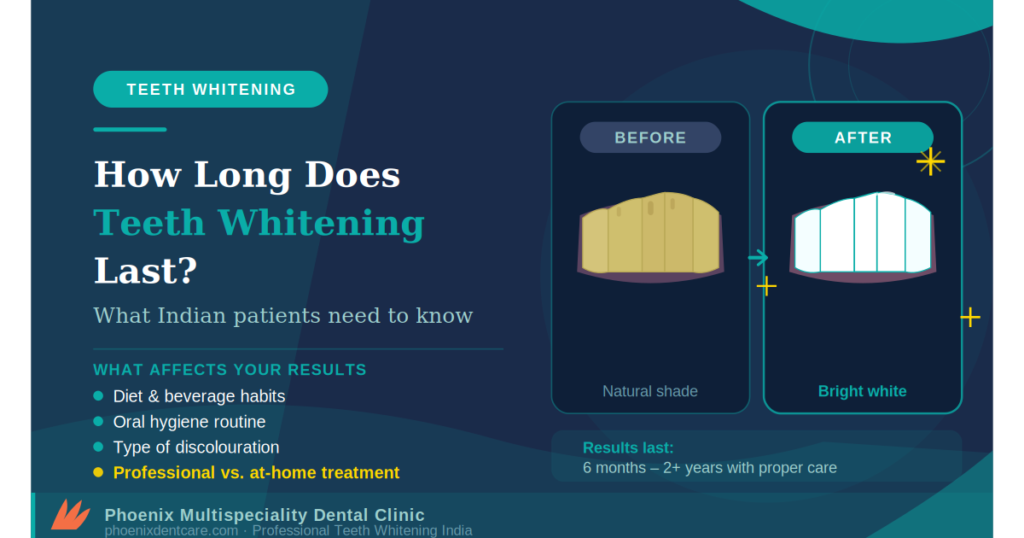
Teeth whitening is one of the most popular cosmetic dental treatments in India — and for good reason. It is relatively straightforward, produces visible results, and gives patients a noticeable boost in how their smile looks and how they feel about it.
But the question most patients have — often the first thing they ask after they decide they want the treatment — is: how long will it last?
It is a completely reasonable question. Teeth whitening is an investment of time and money, and people want to know what they are getting for it. The honest answer is that it depends on several factors — and understanding those factors helps you both set realistic expectations and make the most of your results.
At Phoenix Multispecialty Dental Clinic, we believe in giving patients complete, honest information. So here is what you actually need to know about how long teeth whitening lasts in India.
First, How Does Teeth Whitening Work?
Professional teeth whitening uses peroxide-based whitening agents that penetrate the enamel and break down the compound chains of pigmented molecules that cause discolouration. Over the course of treatment, the accumulated staining that makes teeth appear yellow, grey, or dull is significantly reduced.
The result is a noticeably brighter, whiter smile — achieved without altering the structure of the tooth. The enamel is not damaged by the process when it is performed professionally under the right conditions.
What is important to understand is that whitening is not a permanent change. The teeth themselves are not fundamentally altered. They have been cleared of staining — but they are still capable of staining again over time.
So, How Long Do Results Typically Last?
This is where the honest answer requires some nuance. Professional in-clinic teeth whitening results can last anywhere from several months to a few years — with the actual duration depending on the individual patient’s lifestyle, diet, and oral hygiene habits.
This is not a vague or evasive answer. It is simply the reality of how whitening works. Teeth re-stain based on what they are exposed to — and different people expose their teeth to very different things.
What we can say clearly is that professional teeth whitening, done correctly, produces results that are significantly more durable and more evenly distributed than over-the-counter whitening products. The depth of whitening achieved clinically, with professional-grade agents applied under controlled conditions, is simply not replicable at home.
What Affects How Long Your Whitening Results Last?
Diet and Beverage Habits
Certain foods and drinks stain teeth more readily than others. Tea and coffee are the most common culprits for Indian patients — and India’s relationship with chai means that for many people, daily tea consumption is a given. Red wine, dark-coloured juices, curries, and berries also contribute to staining over time.
None of these need to be completely eliminated after whitening — but being mindful of them, rinsing after consuming them, and not letting them sit on your teeth for extended periods will significantly slow the rate of re-staining.
Tobacco Use
Tobacco — whether smoked or chewed — is one of the most aggressive sources of tooth staining. Patients who use tobacco regularly will find that their whitening results fade considerably faster than non-users. This is one of the clearest cases where a habit directly affects the longevity of dental treatment.
Oral Hygiene
Consistent brushing and flossing removes surface staining before it has the chance to set into the enamel. Patients with good oral hygiene routines will generally find their whitening results last longer. Patients who are inconsistent with brushing and flossing will notice re-staining appearing more quickly.
The Starting Shade and Type of Discolouration
Not all tooth discolouration is the same. Surface staining from food, drinks, and tobacco responds well to whitening and can be dramatically reduced. Intrinsic discolouration — staining that originates from within the tooth, sometimes due to medication, trauma, or developmental factors — is less responsive to traditional whitening. Your dentist at Phoenix will assess your situation during the consultation and advise on realistic expectations based on your specific type of discolouration.
Professional Treatment vs. At-Home Products
In-clinic professional whitening at Phoenix uses stronger whitening agents than anything available over the counter, applied precisely and under supervision. The results are more significant, more uniform, and last longer than at-home strips, gels, or whitening toothpastes. If longevity matters to you — and it should, given the investment — professional treatment is the right choice.
How to Make Your Whitening Results Last Longer
There are practical steps every patient can take to extend the life of their whitening results:
- Avoid or reduce consumption of heavily staining foods and drinks, particularly in the 48 hours immediately after treatment when teeth are most susceptible to re-staining
- Use a straw when drinking dark-coloured beverages to reduce direct contact with the teeth
- Rinse your mouth with water after consuming staining foods or drinks
- Maintain a consistent oral hygiene routine — brush twice daily and floss daily
- Attend regular professional cleaning appointments at Phoenix to remove surface staining before it builds up
- Consider touch-up whitening as advised by your dentist — a shorter top-up treatment to refresh results before significant re-staining occurs
None of these require dramatic lifestyle changes. They are habits that, incorporated into a normal routine, make a meaningful difference to how long your results last.
Touch-Up Whitening: When and Why
Most patients who have had professional whitening find that periodic touch-up treatments — whether in-clinic or with professional take-home kits provided by the dentist — keep their smile looking consistently bright over time.
Touch-up whitening is typically shorter and less intensive than the original treatment. It refreshes the result before re-staining has become significant, which means maintaining the outcome requires less effort than achieving it in the first place.
At Phoenix, we advise patients on the appropriate timing and type of touch-up treatment based on their individual rate of re-staining — which varies from person to person. There is no single schedule that works for everyone.
Is Professional Teeth Whitening in India Safe?
Yes — when performed by a qualified dental team using appropriate materials and techniques. Professional whitening at Phoenix is carried out under supervision, with protective measures in place for the gums and soft tissue, and with agents that are calibrated to achieve results without damaging the enamel.
Over-the-counter whitening products present a different picture. Products that are not specifically designed for dental use — or that are used incorrectly — can cause sensitivity, gum irritation, or uneven results. If you are considering whitening, starting with a professional consultation is always the right approach.
Conclusion
Teeth whitening results are not permanent — but with professional treatment and sensible aftercare, they can be long-lasting and genuinely worth the investment. The key is understanding what affects how long your results last, and making informed choices about how to maintain them.
At Phoenix Multispecialty Dental Clinic, our approach to teeth whitening in India starts with an honest conversation about what your teeth look like, what whitening can realistically achieve for you, and how to make the most of your results over time. That transparency is what guides every patient who comes to us.
If you are considering teeth whitening and want to understand what is right for your specific situation, book a consultation at Phoenix. It is the best place to start.
FAQs — Teeth Whitening India
Q1. How long does professional teeth whitening last in India?
A: Professional teeth whitening results can last from several months to a couple of years, depending on your diet, lifestyle habits, and oral hygiene routine. Patients who consume staining foods and drinks frequently and do not maintain good oral hygiene will see results fade faster than those who take care of their whitened teeth.
Q2. Is professional teeth whitening better than at-home whitening kits?
A: Professional whitening uses higher-concentration whitening agents applied under supervision, producing more significant, more even, and longer-lasting results than over-the-counter products. At-home strips and gels can provide modest results but cannot match the depth and consistency of clinical whitening.
Q3. Does teeth whitening work on all types of discolouration?
A: Professional whitening works best on surface and enamel staining caused by food, drinks, and tobacco. Intrinsic discolouration — staining from within the tooth due to medication, trauma, or developmental factors — is less responsive to traditional whitening. Your dentist will assess your discolouration type at the consultation and advise accordingly.
Q4. Is teeth whitening safe for my enamel?
A: Professional teeth whitening performed by a qualified dental team is safe for enamel. The whitening agents used are designed to remove staining without altering or damaging the tooth structure. Overuse of whitening products, or use of unsuitable over-the-counter products, can cause sensitivity — which is why professional supervision matters.
Q5. How long does the whitening treatment appointment take at Phoenix?
A: An in-clinic professional whitening session at Phoenix typically takes around 60 to 90 minutes. The exact duration depends on the technique used and the degree of whitening being achieved. Your dentist will advise on what to expect at your consultation.
Q6. Will teeth whitening cause sensitivity?
A: Some patients experience temporary sensitivity during or after whitening treatment. This is usually mild and resolves within a day or two. Phoenix takes steps to minimise sensitivity during the procedure and will advise on managing any post-treatment sensitivity. Patients with pre-existing sensitivity should discuss this at their consultation.
Q7. Can I drink tea or coffee after teeth whitening?
A: It is best to avoid tea, coffee, and other staining foods and drinks for at least 48 hours after whitening, when teeth are most susceptible to re-staining. After this window, you can resume normal consumption — though using a straw and rinsing with water afterwards will help slow the rate of re-staining over the long term.
Q8. How often can I have teeth whitening done?
A: The appropriate frequency varies between patients. Whitening too frequently can increase sensitivity and is not recommended. Phoenix will advise on the right timing for any touch-up treatments based on how your teeth respond to whitening and your rate of re-staining.
Q9. Does teeth whitening work on crowns, veneers, or bonding?
A: Whitening agents do not change the colour of dental restorations such as crowns, veneers, or composite bonding. If you have visible restorations in your smile, discuss this with your dentist at Phoenix before whitening — the treatment plan may need to account for colour-matching considerations.
Q10. How do I book a teeth whitening appointment at Phoenix Multispecialty Dental Clinic?
A: Contact Phoenix through our website or by calling the clinic. We recommend starting with a consultation so your dentist can assess your teeth, discuss your whitening goals, and confirm that you are a suitable candidate for the treatment.