
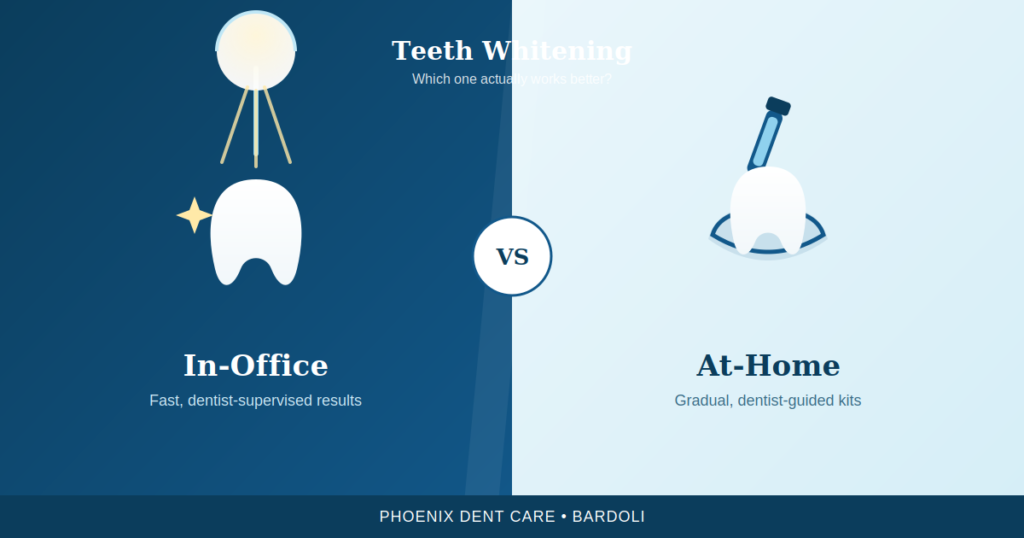
If your teeth have gradually lost their brightness over the years, you’re not imagining it — and you’re definitely not alone in wanting to do something about it. Teeth whitening is one of the most requested cosmetic dental treatments, but with so many options available, from professional in-office treatments to store-bought kits, it’s easy to feel unsure about which one is actually worth your time and money. Here’s a clear breakdown of how each option works.
What Causes Teeth to Lose Their Whiteness
Before choosing a whitening method, it helps to understand why teeth stain in the first place. Surface stains often come from everyday habits — coffee, tea, red wine, and tobacco use are common culprits. Deeper discoloration can also develop over time due to aging, as the outer enamel naturally thins and the slightly yellow layer underneath becomes more visible. Certain medications and excessive fluoride exposure during childhood can also affect tooth color from within, which is why not every type of staining responds the same way to every whitening method.
In-Office Professional Whitening — How It Works
Professional whitening performed at a dental clinic is designed to deliver visible results in a single sitting. A whitening gel is applied to the teeth, and in many cases, a specialized light is used to activate the gel and speed up the bleaching process. Because it’s carried out under a dentist’s supervision, the concentration of the whitening agent can be higher than what’s available in over-the-counter products, while still being applied safely and evenly across your teeth.
This option tends to suit people looking for faster, more noticeable results, or those who want the process closely monitored, especially if they have some sensitivity or existing dental work like crowns or fillings that need to be considered during treatment.
At-Home Whitening Kits — What You Should Know
At-home whitening isn’t necessarily inferior — it’s simply a different pace and approach. Dentist-prescribed take-home kits typically use custom-fitted trays and a whitening gel at a lower concentration than in-office treatments, applied consistently over one or two weeks. This gradual approach can be gentler on tooth sensitivity for some people.
Store-bought strips and generic kits are also widely available, but their whitening concentration and fit are far less controlled compared to a dentist-prescribed option. Without a professional assessment, it’s harder to know if your teeth and gums are actually suited for this level of bleaching, or whether your discoloration will respond to whitening at all.
Which Option Is Right for You?
There’s no single “best” choice — it really depends on a few factors:
- How quickly do you want results? In-office whitening delivers faster, more immediate change.
- How sensitive are your teeth? A gradual at-home approach under dentist guidance may be more comfortable for sensitive teeth.
- What’s causing your discoloration? Some deeper stains respond better to professional treatment than store-bought products.
- Do you have existing dental work? Crowns, veneers, and fillings don’t whiten the same way as natural teeth, which is something only a dentist can properly account for.
The safest way to decide is with a professional evaluation rather than guessing based on a product’s marketing claims.
Common Myths About Teeth Whitening
A few misconceptions tend to keep people from getting whitening done properly. One common myth is that whitening damages enamel — when done correctly and under professional guidance, this isn’t the case. Another is that whitening works the same on everyone; in reality, results depend heavily on your starting shade and the type of staining involved. It’s also worth knowing that whitening doesn’t affect crowns, veneers, or fillings, so if you have visible dental work, your dentist will need to plan around that to avoid an uneven result.
Get a Whitening Plan That Suits Your Teeth
Whichever route you’re leaning toward, the safest and most effective path to a brighter smile starts with a proper dental evaluation. At Phoenix Dent Care in Bardoli, whitening treatments are carried out under professional supervision, with attention to your specific stain type, sensitivity level, and overall oral health — not a one-size-fits-all approach.
Book a consultation to find out which whitening option genuinely works for your teeth.
Frequently Asked Questions
- Is in-office teeth whitening safe?
Yes, when performed by a qualified dentist, in-office whitening is a safe, well-established cosmetic procedure that’s closely monitored throughout the process.
- How long does in-office whitening take?
Most in-office whitening sessions are completed within a single appointment, though your dentist will confirm the exact duration based on your treatment plan.
- Does teeth whitening damage enamel?
No, professional whitening performed correctly does not damage enamel. It’s designed to remove stains from the tooth surface without harming the underlying structure.
- How long do whitening results last?
This varies from person to person based on diet, oral hygiene, and habits like smoking. Touch-up treatments are common to help maintain results over time.
- Will whitening work on crowns or veneers?
No, whitening only affects natural tooth enamel. Crowns, veneers, and fillings will not change color, so your dentist will factor this into your treatment plan.
- Is teeth whitening painful?
Some people experience mild, temporary sensitivity during or after whitening, but it’s not typically painful and usually resolves quickly.
- Can I whiten my teeth if they’re sensitive?
Yes, but it’s important to discuss this with your dentist beforehand, who may recommend a gentler, gradual approach suited to sensitive teeth.
- Are at-home whitening kits as effective as in-office treatment?
Dentist-prescribed at-home kits can be effective, though they typically work more gradually. Over-the-counter kits vary widely in quality and aren’t professionally supervised.
- How often can I get my teeth whitened?
This depends on your teeth and lifestyle habits. Your dentist can recommend a suitable frequency based on your results and any sensitivity you experience.
- Why isn’t my teeth whitening giving me the results I expected?
Certain types of deep or internal discoloration don’t respond as well to whitening. In such cases, alternatives like veneers may be more suitable, which your dentist can advise on.