
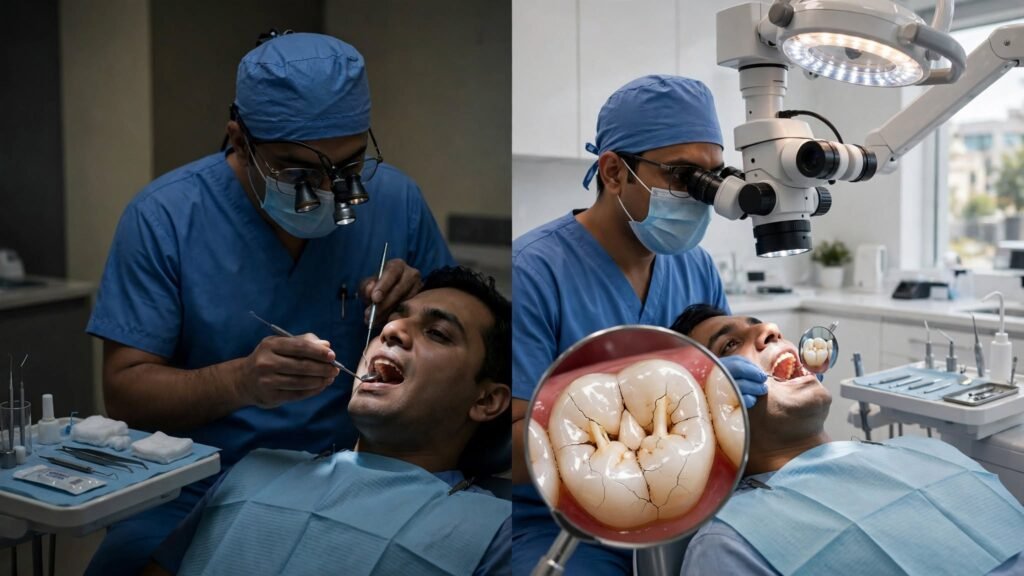
Walk into most dental clinics and you’ll see the usual setup: a chair, an overhead light, and a dentist working with loupes or the naked eye. Walk into a clinic that offers microscope dentistry, and you’ll notice something different — a dental operating microscope positioned right over the chair, giving the dentist a magnified, well-lit view of exactly what’s happening inside your tooth.
It sounds like a small difference, but it changes what’s actually possible during treatment. This guide breaks down what microscope dentistry is, where it makes the biggest difference, and why Phoenix Dent Care in Bardoli built its practice around it.
Microscope Dentistry, Defined
Microscope dentistry simply means using a dental operating microscope during treatment instead of relying on the naked eye or standard magnifying loupes. These microscopes typically offer a much wider range of magnification, along with strong, focused illumination directed exactly where the dentist is working.
It’s most closely associated with endodontics — root canal treatment and retreatment — because that’s where fine, detailed work inside a tooth matters most. But its usefulness isn’t limited to root canals alone, as we’ll get into shortly.
Where Magnification Actually Changes Treatment Outcomes
The value of microscope dentistry isn’t really about the technology itself — it’s about what the dentist can actually see and do with it. A few areas stand out.
Locating Extra or Hidden Canals
Tooth root systems are more complex than most people realize, and it’s genuinely common for a canal to be narrow, curved, or positioned in a way that’s easy to miss without magnification. A missed canal is one of the leading reasons a root canal treatment fails down the line, so being able to spot it in the first place matters.
Detecting Hairline Cracks
A crack running along a tooth or root can be nearly invisible without magnification, especially in its early stages. Under a microscope, these cracks are far easier to identify, which allows the dentist to catch a developing problem before it turns into a bigger one.
Precision During Retreatment
When a tooth needs a re-root canal treatment, the dentist often has to remove old filling material or, occasionally, a small broken instrument fragment left over from a previous procedure. Doing that accurately, without damaging healthy tooth structure, is far easier with a magnified, well-lit view of the canal.
More Conservative Tooth Preparation
Because the dentist can see more clearly, there’s generally less need to remove extra tooth structure just to get a better look at what’s going on. That means treatment can often be more conservative, preserving more of your natural tooth.
Microscope Dentistry vs. Traditional Dentistry
Traditional dentistry, performed with the naked eye or with loupes, still works well for a large share of everyday procedures. Loupes offer a modest, fixed level of magnification and are lightweight enough to wear throughout the day.
A dental operating microscope goes further. It typically offers a much wider magnification range that can be adjusted during the procedure, along with dedicated illumination that lights up the exact area being treated. For routine checkups or simple fillings, this level of detail may not be necessary. For root canal treatment, retreatment, or diagnosing a subtle crack, it can make a real difference in outcome.
Is Microscope Dentistry Only for Root Canals?
Not at all. While root canal treatment and retreatment are where microscope dentistry is used most often, the same magnification and lighting benefits apply to other areas of dentistry as well. It can help with checking the fit and margins of a crown, identifying early decay that might otherwise be missed, and supporting more precise cosmetic work where small details matter.
Why This Matters for Patients in Bardoli and Surat
Until recently, this level of precision dentistry was something patients in smaller towns and suburban areas often had to travel to bigger cities to access. Phoenix Dent Care was set up specifically to change that — it’s the first and only clinic in Bardoli offering dental treatment under a microscope, bringing a level of care usually associated with metro-city clinics to patients closer to home.
For a town like Bardoli, and nearby areas around Surat, that means patients dealing with a failed root canal, a hard-to-diagnose crack, or a complex retreatment no longer need to travel far to get access to this kind of detailed, magnification-guided care.
What Happens During a Microscope-Assisted Procedure?
From a patient’s perspective, the experience isn’t dramatically different from a standard dental visit. You’ll be seated and made comfortable in the usual way, and the dentist will position the microscope over the treatment area rather than leaning in directly. Some microscopes are connected to a monitor, which means the dentist can view a magnified image of your tooth on screen while working with even greater precision.
There’s no additional discomfort involved in using the microscope itself — it’s simply a tool that improves what the dentist can see and how precisely they can work.
The Role of Illumination, Not Just Magnification
It’s easy to assume microscope dentistry is only about zooming in, but the lighting side of it matters just as much. The inside of a tooth is a small, enclosed space, and standard overhead dental lights don’t always reach every angle of a curved canal. A dental operating microscope pairs magnification with a focused light source aimed directly at the working area, which means the dentist isn’t just seeing things bigger — they’re seeing them properly lit for the first time in some of the trickier spots.
This combination is part of why microscope-guided treatment tends to be more thorough. A canal that looks clear under normal lighting can sometimes reveal a missed branch or residual debris once it’s properly illuminated and magnified together.
What to Look for When Choosing a Microscope Dentistry Provider
Not every clinic that mentions “advanced technology” is necessarily using a dental operating microscope for your specific treatment. If precision matters for your case, especially for a root canal, retreatment, or an unclear diagnosis, it’s reasonable to ask a few direct questions before committing to a clinic.
Ask whether the microscope will actually be used for your procedure, not just kept in a back room for select cases. Ask about the dentist’s specific training in endodontics, since operating a microscope well takes practice beyond just owning the equipment. And ask how the clinic handles cases where the first treatment, done elsewhere without magnification, didn’t fully resolve the issue — that’s often where microscope dentistry shows its value most clearly.
Making an Informed Choice
If you’re weighing treatment options for a root canal, a retreatment, or even a routine procedure where precision matters, it’s worth asking your dentist whether microscope-guided treatment is available. It’s not a requirement for every single procedure, but for the cases where fine detail genuinely affects the outcome, it’s a meaningful difference in the quality of care you’re getting.
Frequently Asked Questions
- What is microscope dentistry?
Microscope dentistry is the use of a dental operating microscope during treatment, offering magnification and focused lighting that go beyond what the naked eye or standard loupes can provide.
- Does microscope dentistry cost more than regular treatment?
It can, since the equipment and the added precision it enables represent a higher level of care. Ask your clinic directly for the specific cost for your treatment.
- Is treatment under a microscope uncomfortable?
No. The microscope is positioned above the treatment area and doesn’t add any discomfort to the procedure itself — it simply improves what the dentist can see.
- Which treatments benefit most from microscope dentistry?
Root canal treatment and retreatment benefit the most, since they involve fine detail inside the tooth. It’s also useful for detecting cracks, checking crown margins, and supporting precise cosmetic work.
- Why does magnification matter for root canal treatment specifically?
Root canals can have extra or hidden canals that are difficult to see without magnification. Missing one of these is a common reason root canal treatment fails later on, so being able to see clearly reduces that risk.
- Is Phoenix Dent Care the only clinic in Bardoli offering microscope dentistry?
Yes, Phoenix Dent Care is the first and only clinic in Bardoli to offer dental treatment under a microscope.
- How is a dental operating microscope different from loupes?
Loupes offer a fixed, modest level of magnification worn by the dentist throughout the day. A dental operating microscope offers a much wider, adjustable magnification range along with dedicated illumination focused on the treatment area.
- Can microscope dentistry help catch problems earlier?
Yes. Because it allows the dentist to see fine detail like hairline cracks or early decay, issues can often be identified before they progress into more serious problems.
- Do I need to ask for microscope-guided treatment specifically?
It’s a good idea to ask your dentist whether it’s available and appropriate for your specific procedure, especially for root canal treatment, retreatment, or diagnosing an unclear issue.
- Is microscope dentistry only useful for complicated cases?
It’s most valuable for complex or detail-sensitive procedures, but it can also support more routine treatments where precision improves the outcome, such as crown fitting or early decay detection.