
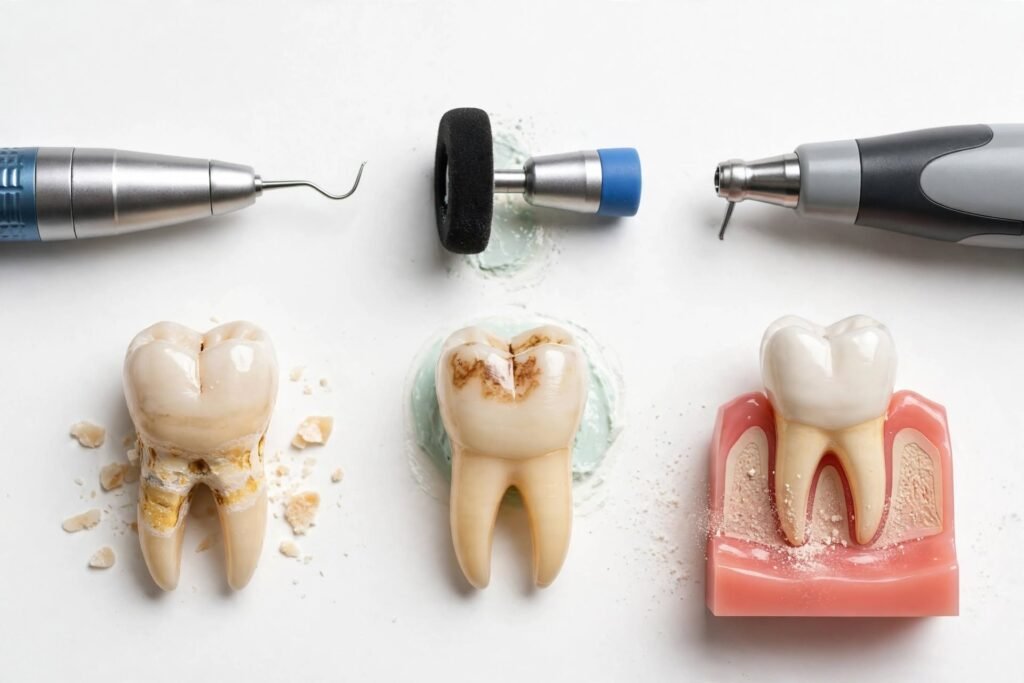
What teeth cleaning actually is: scaling vs polishing vs deep cleaning
People often use “cleaning” for three different things, and that is where much of the confusion begins. Scaling is the main treatment. It removes plaque and hardened tartar from the surfaces of your teeth and just below the gumline. Tartar cannot be removed properly by brushing at home once it has hardened, which is why a professional visit is needed.
Polishing usually follows scaling. It smooths the tooth surfaces and helps remove selected surface stains from tea, coffee or tobacco, leaving your teeth feeling cleaner. Polishing on its own, however, does not treat gum disease.
Deep cleaning, sometimes called root planing, goes further. It is used when gum disease has created deeper spaces below the gumline. It may take more than one visit and focuses on cleaning the root surfaces carefully. So when you compare prices, first check which of these you are actually being quoted for.
What affects the cost
Two patients can pay different amounts for “cleaning” and both prices can be fair, because the work involved is not the same. The city and the type of clinic matter, as rent, equipment and team costs differ across India. A routine visit in a smaller town will not always be priced like a visit in a large metro clinic.
Your mouth matters just as much. The amount of tartar, whether your gums bleed, how deep the gum pockets are, and how long it has been since your last cleaning all affect the time needed. Someone who needs one short sitting is different from someone who needs deep cleaning over several visits.
Technology and what is included also change the quote. Manual cleaning, ultrasonic scaling and air polishing are not identical. Ask whether your quote includes the examination, any X-ray that is needed, fluoride, and a follow-up visit, or whether those are charged separately. That one question explains many price differences. It also helps you compare clinics fairly, because a cheaper quote that excludes essentials you actually need may not stay cheaper once those items are added later on during treatment.
Indicative cost ranges in India, with a clear warning
Published India-wide price guides commonly list broad, indicative ranges like these: routine scaling at roughly ₹500 to ₹2,000, scaling and polishing together at roughly ₹800 to ₹3,000, and deep cleaning at roughly ₹2,000 to ₹8,000 or more, depending on how extensive the treatment is. Treat these figures only as a starting point for understanding the market, not as a fixed fee and not as a promise from any one clinic.
Prices change over time, and they vary by clinic, city, the amount of tartar, gum condition, the number of sessions, and what is included in the quote. A low starting price elsewhere may cover only part of the treatment, while a higher quote may include examination and follow-up.
Phoenix Multispeciality Dental Clinic does not publish a fixed cleaning price in this article, because that would not be honest without seeing your teeth first. Your exact fee at Phoenix, in Bardoli, Gujarat, will be confirmed only after an examination and a written treatment plan agreed before treatment starts. If a price matters to you, ask for that plan in writing and take your time to read it. That approach may feel slower than a price quoted on the phone, but it protects you from paying for treatment you do not need, or discovering extra costs halfway through.
| Type of cleaning | Broad indicative range in India* |
| Routine scaling | ₹500 – ₹2,000 |
| Scaling and polishing | ₹800 – ₹3,000 |
| Deep cleaning | ₹2,000 – ₹8,000 or more |
Which cleaning do you actually need?
The right cleaning depends on your gums, not on which option sounds cheapest. If your gums are healthy and you are coming in for regular preventive care, routine scaling, and polishing if needed, may be enough. The aim is simply to remove everyday build-up and keep your gums healthy.
If your gums bleed when you brush, feel swollen, or if the dentist finds deeper pockets around your teeth, deep cleaning may be advised. That is not an unnecessary extra. It is treatment for gum disease below the gumline, and leaving it untreated can allow the problem to progress quietly.
If you have advanced gum disease, your dentist may suggest a periodontal maintenance plan after the main treatment, with closer follow-up. In every case, the decision should follow an examination, and sometimes an X-ray, not a price list. If you are unsure why a particular cleaning has been recommended, ask the dentist to show you what they can see and explain it in simple words.
How to avoid hidden charges
A clear quote protects you, and a good clinic should be happy to give one. Before treatment starts, ask what the quote includes: the examination, scaling, polishing, any X-ray, and how many visits are covered. Ask, too, whether any additional treatment might be needed if the dentist finds decay, a damaged filling or more serious gum disease during the visit.
Then ask for the plan in writing. It does not need to be complicated. It should state what will be done, in how many visits, and what it will cost, so there are no surprises later. If something changes during treatment, ask why before you agree to it.
How often, and what to expect afterwards
How often you need a cleaning depends on your gum health, your home care, and your dentist’s advice at your check-up. Some people need only routine preventive visits, while others with gum disease need closer, more frequent follow-up. Your dentist will guide you after examining your mouth, rather than applying the same interval to everyone.
After a cleaning, mild sensitivity, slightly sore gums, light bleeding for a short time, or the feeling of small gaps between your teeth can be normal, especially if a lot of tartar was removed. Those gaps were already there; the tartar was filling them. Follow the aftercare advice you are given, brush and clean between your teeth gently, and contact the clinic if pain, swelling or bleeding does not settle, or if you develop fever.
Conclusion: cleaning is preventive care, not just cosmetic
Teeth cleaning is not only about a brighter smile. It is basic preventive care that helps protect your gums and makes problems easier to spot early. If cost has been holding you back, start with a check-up, ask what cleaning you actually need, and ask for a clear written estimate before anything begins. At Phoenix Multispeciality Dental Clinic in Bardoli, you can discuss your teeth, your concerns and your budget openly, and decide with full information. Book a check-up, bring any previous dental records or X-rays if you have them, and take the decision at your own pace.
Frequently asked questions
1. How much does teeth cleaning cost in India?
Published India-wide guides list broad indicative ranges of roughly ₹500 to ₹2,000 for routine scaling, ₹800 to ₹3,000 for scaling and polishing, and ₹2,000 to ₹8,000 or more for deep cleaning. These are estimates only and vary by clinic, city and complexity. Your exact fee can only be confirmed after an examination.
2. What is the teeth cleaning cost at Phoenix in Bardoli?
Phoenix does not quote a fixed cleaning price without an examination, because the cost depends on tartar, gum condition, the type of cleaning needed, the number of visits and what is included. After your check-up at Phoenix Multispeciality Dental Clinic, Bardoli, your fee will be explained in a written treatment plan before treatment starts.
3. Is scaling and polishing the same thing?
No. Scaling removes plaque and hardened tartar from your teeth and below the gumline. Polishing smooths the surfaces afterwards and helps remove selected surface stains. Polishing alone does not treat gum disease, which is why your dentist will advise which combination you actually need.
4. What is deep cleaning, and why does it cost more?
Deep cleaning, or root planing, cleans below the gumline and on the root surfaces when gum disease has created deeper pockets. It takes more time, may need more than one visit, and involves more detailed work than a routine cleaning, which is why it usually costs more.
5. Does teeth cleaning hurt?
Most people find routine cleaning manageable, though you may feel some sensitivity, especially where tartar is heavy or gums are inflamed. Tell your dentist if you feel discomfort during the visit so they can adjust and make you comfortable. Mild sensitivity afterwards usually settles, but contact the clinic if it does not.
6. How often should I get my teeth cleaned?
It depends on your gum health, home care and your dentist’s findings. Some people need only routine preventive visits, while people with gum disease need closer follow-up. Your dentist will advise an interval for you after an examination, rather than a fixed rule for everyone.
7. Does teeth cleaning damage enamel or loosen teeth?
Professional cleaning is intended to remove plaque and tartar, not healthy tooth structure. Teeth can feel different, or gaps can feel more noticeable, after hardened tartar is removed, because the tartar was covering those spaces. If you are worried about a tooth feeling loose, ask your dentist to examine its gum and bone support.
8. Will teeth cleaning whiten my teeth?
Cleaning removes plaque, tartar and some surface stains, so your teeth may look cleaner and feel smoother afterwards. It is not the same as professional teeth whitening, which is a separate cosmetic treatment. Your dentist can explain the difference and whether whitening is suitable for you.
9. What should I ask before I agree to a cleaning quote?
Ask what the quote includes — examination, scaling, polishing, any X-ray and follow-up — how many visits are covered, and whether any additional treatment might be needed. Ask for the plan and cost in writing before treatment starts, so you can decide without pressure.
10. When should I see a dentist promptly instead of waiting for a routine cleaning?
Book promptly if you have swelling, spreading pain, fever, a bad taste that keeps returning, bleeding that does not settle, or trauma to a tooth. A routine cleaning is preventive care; those signs need an examination first so the cause can be diagnosed and treated.